
The latest census data is out. And the numbers reinforce a theme we’ve been underwriting to for years: growth in Texas isn’t slowing, it’s shifting. Not away from the metros, but outward from the urban core into the surrounding suburban ring.
We think about this through a simple lens: Politics. Pricing. Preferences.
Politics
Growth is increasingly shaped at the local level. As urban cores adopt policies and tax structures that make development more difficult and living more expensive, suburban markets position themselves as the alternative: predictable, pro-growth, and aligned with how people want to live. We are seeing these differences in governance play out in real time, influencing both where housing gets built and where people choose to move.
Pricing
The affordability gap is doing the heavy lifting.
In North Texas, that push is clearly visible moving north and east of Dallas into Collin, Denton, Rockwall, and Kaufman Counties. Markets like Celina, Aubrey, and Melissa are absorbing meaningful population growth. When a buyer gets materially more house for less cost, distance becomes a secondary consideration.
Houston is showing the same pattern, just on a larger geographic scale. Growth is concentrating in the outer ring: Fort Bend County (southwest), Montgomery County (north), and Liberty County (northeast). These areas continue to capture households priced out of closer-in neighborhoods, while still benefiting from job access and improving infrastructure.
Preferences
What started as a pandemic shift has become durable behavior.
Households are prioritizing space, flexibility, and quality-of-life over proximity to downtown. Hybrid work has reduced the penalty of distance, and increasingly, jobs are following rooftops. Suburban nodes like Frisco, McKinney, The Woodlands, and Katy are no longer just bedroom communities, they’re becoming employment centers in their own right.
What the Data Is Saying
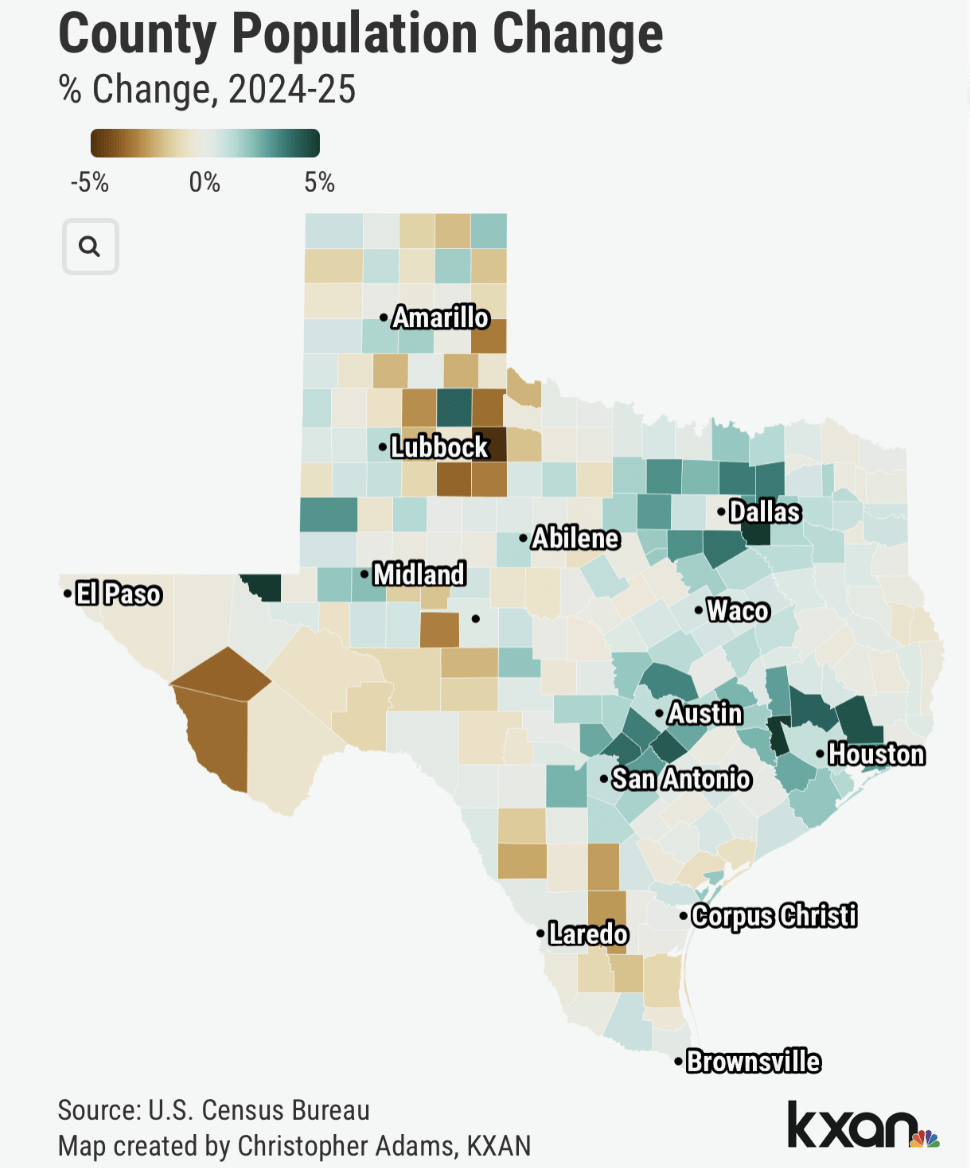
The above map illustrates our thesis. The darkest pockets of growth are not in the urban cores. they’re in the counties surrounding them. That’s where population is compounding the fastest, and where new supply is being delivered to meet it. It’s where we want to be and where we’re working to be a first mover, directly in the path of this continued growth.
For us, the takeaway is straightforward: continue to focus on high-growth suburban corridors with strong incomes, retail tailwinds, and infrastructure expansion. The path of growth isn’t theoretical—it’s showing up clearly in the data, and even more clearly on the ground.
